
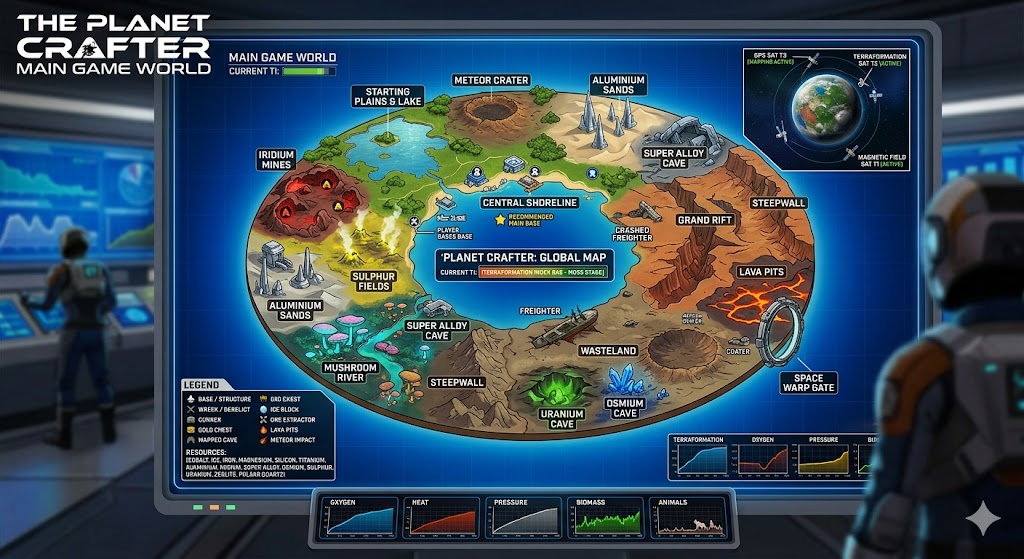
In the ever-evolving survival simulation experience of The Planet Crafter, the map plays a central role in shaping how players explore, gather resources, and ultimately terraform an alien world into a habitable paradise. Unlike traditional games that provide a fully revealed map from the beginning, this game embraces mystery and discovery. Players are encouraged to navigate vast landscapes, uncover hidden locations, and strategically plan their expansion based on environmental conditions and resource availability.
As interest continues to grow, many players frequently search for terms related to the planet crafter map, including interactive versions, resource-focused layouts, and updated versions for recent game builds. This article dives deep into everything you need to know about the map system, from understanding terrain zones to locating rare materials and exploring future updates expected in 2025 and 2026.
Understanding the Planet Crafter Map System
The map in The Planet Crafter is not immediately accessible in a traditional sense. Early gameplay requires players to rely on memory, observation, and environmental cues. This design choice enhances immersion and encourages players to actively engage with their surroundings.
As progression continues, players unlock mapping tools and chips that provide more structured navigation. These upgrades allow for a clearer overview of explored regions, making it easier to track key areas such as resource deposits, wrecks, and biome transitions.
The absence of a static map early on is intentional. It transforms exploration into a meaningful part of gameplay rather than a background mechanic.
Interactive Map: A Game-Changer for Exploration
One of the most sought-after features by players is an interactive version of the planet crafter map. These maps, often created by the community, allow users to zoom in, toggle layers, and identify specific points of interest.
Interactive maps typically include:
- Resource locations such as iron, cobalt, and iridium
- Shipwreck coordinates
- Biome boundaries
- Secret caves and hidden areas
These tools significantly reduce the trial-and-error aspect of exploration while still preserving the thrill of discovery. For new players especially, interactive maps can provide a helpful starting point without completely removing the challenge.
Resource Mapping: Where to Find What You Need
Resource management is at the heart of survival and terraforming. Understanding where materials spawn is critical for efficiency and long-term planning.
Different regions of the map are rich in specific resources:
- Aluminum fields are often located in open desert zones
- Iridium caves are found in deeper, more dangerous regions
- Uranium deposits are typically hidden in isolated or hard-to-reach areas
- Osmium is frequently discovered in ice-covered zones or underground
Players who familiarize themselves with these patterns gain a significant advantage. Instead of wandering aimlessly, they can plan targeted expeditions to gather exactly what they need.
Key Locations Every Player Should Know
As you explore, certain landmarks stand out due to their importance in progression. These locations often contain valuable loot, rare blueprints, or environmental clues that contribute to the larger terraforming narrative.
Shipwrecks
Scattered across the map, wrecks are among the most rewarding places to explore. They contain:
- Advanced crafting materials
- Blueprint chips
- Storage containers with rare items
However, navigating these structures can be tricky due to maze-like interiors and limited oxygen supply.
Caves and Underground Systems
Caves are essential for locating rare minerals such as iridium and osmium. They often require careful navigation and preparation, as some areas are dark and difficult to traverse.
High Elevation Zones
Mountainous regions provide unique perspectives and sometimes host rare resources. These areas also become important as the planet begins to change with terraforming.
Evolution of the Map: 2025 and 2026 Updates
The planet crafter map is not static. With each update, the game world evolves, introducing new areas, environmental changes, and additional resources.
Map Changes in 2025
In 2025, players saw:
- Expanded biomes with more diverse terrain
- Additional wreck sites
- Improved environmental transitions as terraforming progresses
Water levels began to rise more dynamically, transforming previously dry areas into lakes and rivers.
Expected Features in 2026
Looking ahead, the 2026 version of the map is expected to bring even more enhancements:
- Larger playable areas
- More complex cave systems
- Enhanced vertical exploration opportunities
- New resource types and distribution patterns
These updates aim to make exploration feel fresh even for experienced players who have already mastered earlier versions of the map.
Mapping Chips and Navigation Tools
As players progress, they unlock mapping chips that enhance their ability to navigate efficiently. These chips act as upgrades to your mapping interface and provide valuable information.
Common mapping chip features include:
- Displaying player coordinates
- Revealing terrain outlines
- Marking points of interest
- Highlighting resource-rich zones
These tools transform exploration from guesswork into a strategic activity. Players can create routes, mark important areas, and avoid unnecessary risks.
The Moon and Off-World Mapping Possibilities
Another fascinating aspect of the game’s expanding universe is the potential inclusion of off-world locations, such as a moon environment. While still a topic of speculation and ongoing development, many players are eager to explore how mapping would function beyond the primary planet.
A moon-based map could introduce:
- Low-gravity exploration mechanics
- Unique resource types
- Smaller but more densely packed environments
This would add an entirely new dimension to navigation and survival strategies.
Humble Beginnings: Early Map Experience
The early stages of gameplay are intentionally minimalistic. Players start with limited tools, no clear map, and only basic survival equipment.
This humble beginning serves several purposes:
- Encourages exploration and curiosity
- Builds a sense of achievement as new tools are unlocked
- Makes later mapping upgrades feel meaningful
By the time players gain access to advanced navigation systems, they already have a deep understanding of the terrain.
Strategies for Efficient Exploration
Mastering the planet crafter map requires more than just knowledge—it demands strategy.
Plan Before You Travel
Always prepare for expeditions by carrying:
- Oxygen supplies
- Food and water
- Storage containers
This ensures you can stay out longer and bring back more resources.
Use Landmarks
Memorize key visual markers such as rock formations, cliffs, and wreckage. These help with navigation even without a fully developed map.
Expand Gradually
Instead of exploring randomly, expand outward from your base in a structured way. This minimizes risk and maximizes efficiency.
Why the Map Matters in Terraforming
The ultimate goal of the game is to transform a barren planet into a thriving ecosystem. The map plays a crucial role in this process.
As terraforming progresses:
- Ice melts and reveals new areas
- Water bodies form and reshape the terrain
- Vegetation begins to appear
These changes not only affect gameplay but also alter how players interact with the map. Routes that were once accessible may become submerged, while new pathways open up.
Understanding these shifts is essential for long-term planning and base placement.
Conclusion
The planet crafter map is far more than a simple navigation tool—it is a dynamic, evolving system that reflects the player’s progress and the planet’s transformation. From early exploration without guidance to advanced mapping with chips and interactive tools, the journey is both challenging and rewarding. With ongoing updates and the promise of new features in future versions, the map will continue to grow in complexity and importance. Whether you are searching for resources, uncovering hidden locations, or planning your next expansion, mastering the map is key to success in The Planet Crafter. By understanding its mechanics, leveraging available tools, and adapting to changes over time, players can fully immerse themselves in the experience and shape the planet into a world of their own creation.